Syllabus for Bamidbar I
The First Generation: On the Road
Introduction
The following is a syllabus of subjects to be covered when teaching the first half of Sefer Bimidbar during a one-semester course. The course covers the challenges of the Second Generation in the 2nd year in the desert. The target audience is a high school class that has familiarity with Bimidbar at a pre-high school level.
Area Covered
The primary text to be covered is from chapter 1 through chapter 20, ending with the the weekly portion of Chukat, immediately after the statute of the Red Heifer. Medieval Meforshim will be referenced extensively, requiring either a Chumash Torat Chaim or a Mikro’ot Gedolot with at least Unklos, Rashi, Rashbam, Ramban, and Eben Ezra. For less advanced classes, an English Chumash and Rashi should suffice. The course will require the study of secondary texts throughout Tanach. The use of Meforshim outside of the primary text range is kept to a minimum; however, an occasional Gemara, Medrash Agada, Rambam, and Da’at Mikra map will require photocopies.
Goals
The events of the First Generation are broken down into a series of subjects that follow more or less sequentially in the text. The goal of this document is to lay before the teachers a series of overarching ideas that are dealt with in this section of Bimidbar, and offer an approach to teaching them. How these subjects are imparted to the students depends on the style of the teacher. This document does not supply lesson plans or worksheets. Each subject may constitute many lesson plans, tests, projects, reading exercises, etc. The amount of time to be dedicated to each subject is also up to the teacher.
A number of goals are enumerated for each subject. Most goals fall into one of two categories. One type of goal aims to enhance the student’s understanding of both the relationship between First Generation and God in the desert in specific, and the Jewish people and God throughout history in general. These goals develop the students’ theological, ethical, and meta-historical understanding of their role as Jews. The second type of goal is geared towards improving the learning capabilities (reading and decoding skills, for example) of the students.
For the course to be successful, the goals should help our students learn to:
1) Read and decode the text, with fluency depending on the class level.
2) Understand the storyline or laws being described.
3) Understand the storyline or laws within the context of the history of the Second Generation in particular, and the Jewish people in general.
4) Think critically about the message being delivered by means of the narrative or laws.
5) Read and understand Midrashic and Medieval commentary of the narrative or laws.
6) Appreciate the excellence and uniqueness of our Midrashic and Medieval commentaries.
7) Recognize interpretive disputes in the commentaries, and allow the students to “choose their favorites.” This should be fun; it’s like picking a favorite ball team!
Different subjects lend themselves to different goals. This document suggests possible goals for each subject, and suggests procedures for imparting these goals. Teachers may wish to add or modify the goals to match their own style and sensibilities. The procedures are supplied solely as my own ideas, which will probably develop into my lesson plans.
Syllabus
Subject 1: Numbers
The common name of the book is “Numbers,” found in the LXX, and, as a result, the Latin translations, and ultimately the English translations as well. Talmudic sources also identify the book as “Sefer Hapikudim.” Asking students why the book is called “Numbers” should lead them to the following knowledge:
· Translations. Students might be surprised to know that there were translations before Art Scroll. (The fact that some of the translations based their exegesis on Rabbinic interpretations, much like Art Scroll is based on Rashi, might be interesting too.) In particular, the LXX translations should be noted, since it was written for Jews by Jews. This knowledge will integrate some Jewish history of 3rd century Egypt and Judah. Advanced classes might want to read from the Letter of Aristeas, or from the Talmudic passages on the matter. Balancing between the myth and the history might be a challenge.
o Use the Jewish encyclopedia for information on the LXX. See if it points them to any primary sources, and have them follow those up as well.
o
The issue of apocryphal books might be appropriate for older
and more advanced classes.
· What’s in a name? The difference between naming a book based on the perceived theme of the book, as opposed to using an early (or the first) significant word can be explored. It might be a good exercise to see what the students would have named our book, in light of their previous knowledge of main and ancillary themes. This will also serve as a refresher, and a way of gauging how familiar the book is to particular class. It would also be interesting if any students selected “Bimidbar”—the Jews wandering around in the desert—as representative of the primary theme. (The same exercise can also be done with the weekly parashot from other areas in the Torah, so that the students get a feel for it. It’s easier to find a theme in a single weekly parsha than in an entire book. Or then again, maybe it isn’t. Let the kids decide. Of course the history and artificiality of the weekly breakdowns should be noted, which leads to the idea of petuchot and stumot.)
o
The fact that there are two censuses in the book is
significant. The fact that
they take place 38 years apart is also significant.
If this doesn’t come up here, it should be introduced when we
timeline Bimidbar (and Shemot), which is lesson #2.
· Key words. The LXX name is a good introduction for analyzing one of the Milot Manchot of the opening sections of Bimidbar, if not the book on general: “PKD”. It may be difficult to identify this word as the Manche since there is so much white noise of names and numbers in the opening chapters. It is probably best to prove the issue of Milat Mancha from other places in Tanach: words that are intentionally used to create a mood or to focus the reader’s attention to a theme. Some examples:
o Avraham and Avimelech: Genesis chapter 21:22-34. “SV’” See if the kids can identify the word which is used both for “Seven” and for “Swearing”.
o
Yona: Chapter 1:1-5. The “YRD” word is a favorite. It’s an easy chapter to read, the students are familiar with
it, and it’s always good to touch on Yona in September. Notice the variant use of Vayeiradem in the last
verse.
o
Iyov: The
disaster section in chapter 1:13-22. The word “Pol” sets the tone.
Notice also the alternate use of “Tiflah” (see commentaries for
the difficult translation) in the last verse.
Notice that in all these examples, not only is the word overstressed, the
Tanach uses the same stem (or a close one) for a different purpose, which
serves to further highlight the key word.
·
 PKD
– A quantitative analysis. Once
PKD is identified as a key word, it is important to get a sense of
the Torah (or Tanach) usage. This
will become important for understanding the meaning of the word, but for
now, getting a sense of how to find a word is important.
Either a concordance or the Bar Ilan Responsa software is a good
place to start, and both are important skills to teach.
I believe that the latter is not only a better tool, but the
results will be more startling and meaningful.
PKD
– A quantitative analysis. Once
PKD is identified as a key word, it is important to get a sense of
the Torah (or Tanach) usage. This
will become important for understanding the meaning of the word, but for
now, getting a sense of how to find a word is important.
Either a concordance or the Bar Ilan Responsa software is a good
place to start, and both are important skills to teach.
I believe that the latter is not only a better tool, but the
results will be more startling and meaningful.
o
 Open
Bar Ilan Responsa, and clock on the “Search” menu or the search icon
Open
Bar Ilan Responsa, and clock on the “Search” menu or the search icon
 .
.
o
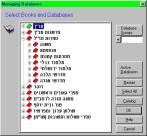
Click on “Choose Databases”
 and then make sure than
only “Tanach” is highlighted in green.
(You might want to limit the search only to the Pentateuch.)
and then make sure than
only “Tanach” is highlighted in green.
(You might want to limit the search only to the Pentateuch.)
o
The search itself is a bit complicated, since “PKD” is a tough word to
search on because of its numerous suffixes and prefixes, and the fact that
is can be spelled both plene (PKUD) and defective (PKD).
The correct (albeit non-intuitive) way to search is on
 , which includes alternate spellings (!) and prefixes (*) and suffixes
(*). Selecting
, which includes alternate spellings (!) and prefixes (*) and suffixes
(*). Selecting 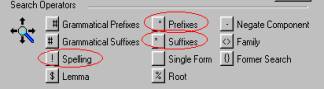 these
options is not easy, and therefore can be frustrating for the students.
Please consult your local computer person for help before trying it
out in the classroom. (A quick trick: always highlight the word before selecting
from the “Search Operators.”) Of course, the students can try
different options and compare the results.
these
options is not easy, and therefore can be frustrating for the students.
Please consult your local computer person for help before trying it
out in the classroom. (A quick trick: always highlight the word before selecting
from the “Search Operators.”) Of course, the students can try
different options and compare the results.
o
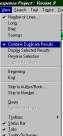
After the results come up, make sure the students select “Combine
duplicate results” from the “View” menu.
Any of the 318 results in the results screen can be clicked on to
open the text.
o
 The
first item to note is the quantitative implications.
PKD appears in individual verses as follows: Bereishit (7), Shemot
(12), Vayikra (4), Bimidbar (93), and Devarim (2).
The results speak for themselves!
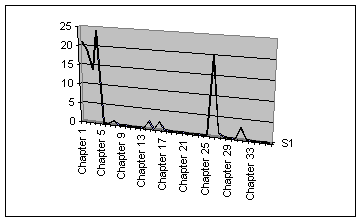
A further item would be to identify the spread in Bimidbar across
chapters. Once could use a
spreadsheet, or just mentally identify the results.
The results should quickly bring up a study of chapter 26, which in
turn brings up the issue of the 40 year spread in Bimidbar, and the need
to create an understanding that the book deals with two distinct
generation, and something of a “do-over.”
The
first item to note is the quantitative implications.
PKD appears in individual verses as follows: Bereishit (7), Shemot
(12), Vayikra (4), Bimidbar (93), and Devarim (2).
The results speak for themselves!
A further item would be to identify the spread in Bimidbar across
chapters. Once could use a
spreadsheet, or just mentally identify the results.
The results should quickly bring up a study of chapter 26, which in
turn brings up the issue of the 40 year spread in Bimidbar, and the need
to create an understanding that the book deals with two distinct
generation, and something of a “do-over.”
·
PKD – A qualitative analysis.
Once the key word is identified and located, it is important to
understand the meaning of the word. Before
commentaries or dictionaries are consulted, the students can see how the
word is used elsewhere in Tanach, and identify meanings from context.
This could be a great BM and at-home assignment, since it will take
quite a while to track down all the significant places, and look up
translations. Advanced classes should certainly try to harmonize the
translations, if possible. This
turns them into exegetes without even knowing it!
All students should be able to group like usages, which should
uncover all kinds of interesting things.
Note that the occurrence in Shemot 30:12 brings up the whole idea
of the permissibility of a census, as will be discussed below.
This work can be followed up with study of the Ramban on Bimidbar 1:2-3
“Tifkidu Otam.” Notice
that Ramban seems to imply that the word “SPR” should have been used,
since counting is what is going on here, and the word “PKD” indicates
that the count was done in accordance with Shemot 30:12.
For advanced classes, the Ramban’s struggle raises the issue of
the sin of the census. Why is
this counting OK, and others not OK?
Skill review
-
The Septuagint and its history.
-
Skills in Bar Ilan Responsa or Concordance
-
Identifying variable meanings of words and grouping like ideas
-
Identifying the correlation and cross references of verses in different books of the Torah
-
Parshanut: Rashi and others
Subject 2: Making Census
·
Why Count? Why are the
Jews being counted. Rashbam
on verse 1:2 talks about war and going into Israel.
Rashi on verse 3 seems to agree with the Rashbam, but the famous Rashi on
verse 1 talks about a count of endearment, and points to the following
events that were all followed up by a count:
1. On their way down to Mitrayim (Bereishit 46)—the counting seems to be protective in nature, since they are about to go into exile.
2. On their way out of exile (Shemot 12:37).
3. Following the sin of the Golden calf (Shemot 30:11-16)—counting to check how many are left, like a shepherd checking his flock.
4. When the Mishkan as built and the Schina evtered the camp (Bimidbar 1)
Rashi does not does not reference Bimidbar 26
here, but there (26:1) at first goes with reason number 3, since it
follows the destruction that resulted from the sin of the Ba’al Pe’or
and the Midianite girls. This
is ties to the broken verse 1, and issue that will be dealt with later.
The question is: does the break indicate a connection between the
the two parts of the verse (Mageipha leads to counting), our does it
indicate a break with no thematic connection.
One might say that Rashi prefers the latter view since he gives a
different reason: when a leader inherits a people, they must be numbered,
meaning that the counting in chapter 26 really dovetails with 27:12-23 and
the transfer of power to Yehoshua. This
gives an explicit reason for number 2 in our list, which Rashi did not
supply in his commentary on 1:1.
See Rashi on Shemot 30:16 (the Golden Calf incident). The kids can be challenged to see of his reason stays the
same. This Rashi also
critical, since it brings up the fact that the counting in Bimidbar is the
second of the three censuses in the Desert, the first being before the
building of the Mishkan. Make
sure to see Shemot 38:26, where the actualization of 30:11-16 is
described. (The complex issue of the double counting with no change and
the two definitions of a year, cultic in Nissan vs. cosmological in Tishri
might be worthwhile to introduce, especially of the students are learning
Kings, since regarding regnal years, Israel in the North was probably
counting from Tishrei, and Judah in the south was counting from Nissan.
For more in the see “Chronology” in the Encyclopedia Mikrit.
Also, see Ramban on 30:12 starting from “…viAni Tamah…” who
raises the difficult issues in Rashi’s solution.
See also Eben Ezra’s solution in his short commentary to Exodus
38:25.) The reason for the
first counting are very much involved in the motivation for building the
Mishkan, where Rashi and Ramban take very different views. I believe that resolving this issue is more apropos to the
study of Shemot. Simply
recognizing the exsistince of an earlier cencus, should help the work the
students in Bimidbar.
What is quite challenging is the Rashi on Shimot 30:15 where he seems to give a totally different reason: the need for temple construction or maintenance.
Returning to the third cencus, the fact that
chapter 26 is in the second generation, 39 years later in the 40th
and final year in the desert should not
be underemphasized. Note
verses 26:63-65. Note also
that the census numbers have, of course, changed a bit.
See also Divarim 10:12-22, especially the
last verse, which may explain why the count in Shimot 12:37 is only
approximate. Compare verse 16
with Genesis 17:2.
The Ramban on Bimidbar 1:45 sights just about
every reason mentioned above, and presents them beautifully.
Also, he ends with an important idea for the study of
BiHa’alotcha: “Had the Miraglim incident not occurred, they would have
gone there [to Israel] immediately.”
Finally, the purpose of the census seams to
be described by the repeating phrase “íúáà
úéáì íúçôùîì íúãìåú”.
See “Standard Deviations,” below, where this phrase is
described in detail.
·
Standard Deviations. Analyzing the actual numbers of each tribe may be a little
dry, but I think that it might uncover a worthwhile points that will be
crucial for understanding the Ba’al Pe’or incident, among others. Note that during the counting of the individual tribes, two
have textual deviations from the norm.
The usual structured is as follows:
o
לִבְנֵי
“To the children of [name-of-tribe].”
The word “To” is absent by Naphtali, which is not too suprising
since they are the last tribe mentioned.
A more significant change seems to appear for the first tribe:
Reu’van. It reads “There
were to Reu’ven, the first born of Israel.”
The “first born of Israel” can be explained away as simply a title,
which is only appropriate for Re’uven.
However one must explain what the title has to do with the census?
(The answer to this is further predicated on the reason for a
census, which, as stated above, is no simple matter.)
Also, hadn’t Re’uven already lost their first born status, as
per I Chronicles 5:1? They
were certainly not serving in the Mishkan, nor were they receiving a
double land inheritance (as was Joseph).
Of course, perhaps the issue was not so simple, since I Chronicles
5:3 seems to contradict verse 1. Perhaps
verse 1 was inserted as a prologue by Ezra to moderate verse 3.
Keep in mind that some Re’uvenites thought they deserved first
born privileges and should have been serving in the Mishkan, hence the
involvement of On ben Pelet the Re’uvenite in the theological coup de
tat attempted by Korach. (Dathan
and Aviram were also from Re’uven—Devarim 11:6—but On’s motivation
was clearly much purer than D & A, and he might have felt that the
continued loss of Re’uven’s first born status was underserved.
D & A’s stated goal was to go back to Egypt!)
The fact that On did not share the popular support given to Korach,
and in fact disappears from the coup before it really gets moving,
underscores the general acceptance of the tribe of Levi as the priests.
More on this when we get to parshat Korach.
The second deviation is the phrase “There were [to]” (VaYihiyu).
Perhapos this word does not refer specifically to Reuven, but to
all the tribes. The section
then reads as follows: An they [Bnei Yisrael] were [as follows]:
The children of Re’uven…”
This would balance the first and last tribes (Re’uven and
Naphtali), both of whom would miss the word “To.” Of course this flies
in the face of the Messoretic cantillations, but I think it has some
merit. Still, the point might
be too narrow.
o
תּוֹלְדֹתָם
לְמִשְׁפְּחֹתָם
לְבֵית
אֲבֹתָם “Each child associated to a family, and each family
associated with a major household;”
my loose translation. Here’s
the JPS: “The registration of the clans of their ancestral house;” and
here’s Artscroll: “their offspring according to their families,
according too their father’s household”
I think that Artscoll misses the importance of the “Beit Avot,”
and issue that we will get to in chapter 1 vocabulary, below.
Either way, this section is parallel to verse 18, which is
describes the cencus as a general whole (and which by skipping the detail
could have been followed directly by verse 46).
After describing the event in general, the details for each
individual tribe are given. Two
changes should be noted between the general and the detail: 1) the root
“YLD” is a passive verb in verse 18, as opposed to by the individual
tribes where it is an object; 2) the connecting “L” in
“mishpichotam” by the tribes changes to “Al” in verse 18.
Note Onkelos who leaves the detailed “Toldotam” alone, but
changes the general “VaYityaldu” to “VaItYachasu.”
See Rashi who follows Onkelos’ lead, as opposed to Ibn Ezra who
sticks closer to “YLD” meaning “born.”
Ramban is beautiful here since he connects it with the formation of
the camp into tribal units, mentions the second census, and also deals
(albeit obliquely) with the problem of using the non Jews of the Eirev Rav
as population padding!
There is no deviation from the norm here.
This phrase is repeated identically by each tribe.
This phrase may then indicate the purpose of the census: either for
the formation of the tribes into marching order or the division of the
land of Israel. As we will
see, by the Encampment Lessons, below, the camp of Israel in the desert is
directly related to the encampment of Israel in the promised land.
o
בְּמִסְפַּר
שֵׁמוֹת “As listed by name,” so JPS. “By
number of the names,” so Artscroll.
Based on the Ramban (at the very end of verse 2 or 3 depending on
your chumash) where he deals with the counting sin of David, “Bimispar
Shemot” indicates that the people were not counted directly, but gave
their half shekel, where they indicated their names.
The Ramban gives reason for the individual pronuciation (or
inscribing?) of the names inverse 45 where he sites a medrash about the
desire to emphasize the greatness of each individual.
I think that this is also Rashi’s source for his commentary on
the first verse in Shemot.
It seems possible though, based on the second census, specifically
Bimidbar 26:52-56, that “Number of names” is referring to the names of
the Beit Avot, or ancestral major families heads, that are enumerated in
the second census, and by Levi in the first census.
This interpreatation would connect the phrase “BiMispar Shemot”
with the preceding “LiBeit Avotam,” which once again flies in the face
of the Massoretic cantillations. Also,
twice it says “BiMispar Shemot LiGulgulotam” which can only be
referring to individuals. It
also raises the issue of the two deviations.
By Re’uven and by Shim’on alone, the phrase “BiMispar Shemot” is
followed by “LiGulgulotam,”
indicating a head count. Rashi
points out that this indicates the half shekel, which is a “Cofer” for
their heads, as indicated during the first census (in Shemot), as is
certainly indicated by connecting Shimot 16:16, chapter 30 and chapter 36,
especially 36:26. Note also
that the general account of the census described in verse 18 includes the
object “LiGulgulotam” but only after the description of the age.
In all twelve detailed accounts the age restriction is followed by
“all that go out to war.” The
questions then are: why does it only appear twice, and why does it appear
in the wrong place? Answers
would be appreciated, however there may be connection to the final
deviation from the norm…
o
מִבֶּן
עֶשְׂרִים
שָׁנָה
וָמַעְלָה--כֹּל,
יֹצֵא צָבָא
“Every
male, 20 up, all who go to war” followed by an additional verse “Their
numbers for tribe [tribal name]: [number]. פְּקֻדֵיהֶם,
לְמַטֵּה
This formula appears for every tribe with one exception: Shim’on.
There the word “numbers” (in singular Pikudaiv” rather than
the plural “pekudeihem”) is repeated, preceding “Bimispar Sheimot
LiGulgelotam.” JPS
translates “their enrollment as listed by name…those
enrolled…” Artscroll translates: “its numbers, by numbers of
the names…” The JPS
handles the redundancy a little better, but neither deals with the
redundancy.
The solution may be, as usual, in comparison with the second census.
There the singular form is used to indicate that the tribal lands
must be divided according to each tribe’s “pekudaiv.” However, as we
will discover in Yehoshua 19:9 (and as is hinted at in Ya’akov’s
blessing to Shim’on in Genesis 49:7), Shim’on received no property!
(It seems only fair to note that while the singular form appears
only by Shim’on in chapter 1, when the numbers are repeated in the
encampments description in chapter 2, the plural and singlular forms are
issued seemingly interchangeably, and issue that might be dealt with
later.) The question than
becomes: why did Shim’on receive no land?
Here a population comparison between the first and second censuses
(in Bimidbar) is very telling:
The Numbers
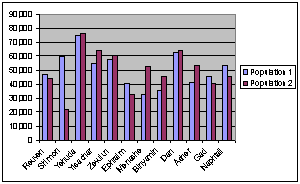
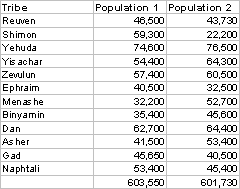
The Deviation:
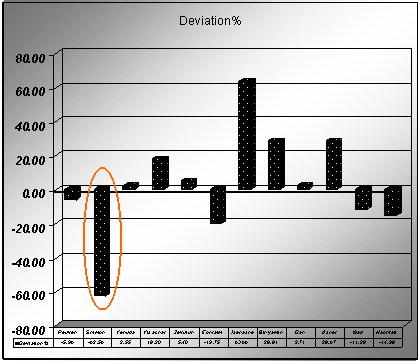
Almost two thirds of the tribe of Shim’on disappears! The disappearance will be taken up later in the Sin of
P’eor, Cazbi and Midyanite girls, and Zimri of Shim’on. For now, it is enough to note the change, and the possible
foreshadowing of this terrible loss in the word “pekudaiv.”
(One is also drawn to the nearly two thirds increase in Menashe.
There is nothing in this census which points to this increase, but
the tribe’s desire to take extra land in the Golan and Gil’ad, might
be connected to this exceptional grown during the wanderings.
As we will see the 2 ½ tribes are not really a unit, and Re’uven
and Gad’s motive for taking land on the East Bank of the Jordan river is
quite different than Menashe’s. See
Bimidbar 32:1, where Menashe is never mentioned!
Also, the how when and why of Menashe’s conquest of Chavvot
Ya’ir and the Gilead—Bamidbar 32:39-41—will be dealt with later.)
·
The Sin of the Census. The following questions should be addressed when dealing with
the census as sin issue: Why is it a sin to count directly?
Why does this counting not classify as a sin? How does the Shekel
substitution change the reality of the counting?
Why did what David did classify as a sin?
I believe that this issue is outside of the scope of teaching
Bamidbar, since it really belongs Shemot 30 and 2 Shmuel 24 (and 1 Divrei
Hayamim 21), and requires, among other things, understanding the
Rashi/Ramban dispute regarding the purpose of the Mishkan, exploring the
meaning of “CPR,” and understanding why David was being punished and
what exactly he did wrong. Was
the census a sin, or was it part of the punishment? (Notice that the Satan’s plays a direct role in the Divrei
HaYamim version, and in 2 Shmuel Yoav’s travels are described as
“Shut,” which matches the Satan in Iyyov 1.
Having said that, the students may well ask why this census is O.K. but
why what David did was not O.K. After
all, Ramban asks the question here, and I think his answer is a good, if
not exhaustive answer. See
Ramban verse 1:2-3 “Tifkedi Otam,” especially staring with “ViAmar
BiDavid…” Amazingly he says that David used a Shekel and did not count
directly (going against Chazal in TB Berachot 62b on their commentary to 1
Shemuel 26:19!), and (to oversimplify the Ramban) a census may only
performed when needed, as here in times of war preparedness, and simply to
give onself the pleasure of knowing what a great a nation one rules over,
as by David. Of course many answers, even the second one given by the
Ramban here, touch on issues of the Evil Eye, and metaphysical
susceptibility introduced by an individual being counted; however,
Ramban’s rationalist first answer seems more apropos, especially since
it supports the idea that the counting was for military reasons, and keeps
our parasha firmly on a Zionist track.
Perhaps Rashi’s statement on Shmuel B 24:1 deserves mention,
since it teaches the important lesson of humility.
In spite of Rashi’s awareness of divrei Chazal he says merely
“I don’t know.”
·
Vocabulary:
o
פקד
o
שאו
o
תּוֹלְדתָם
o
נִקְּבוּ
בְּשֵׁמת See
Een Ezra on this (“explicitly named”), who also has the consensus of
the classical commentators on Yishayahu 62:2.
Onkelos here also agrees, and it fits with the phrase “קְרוּאֵי
הָעֵדָה.” I personally can’t escape the other uses of this word, which is a) to
hole, and b) to curse. The
simple harmonization is that there was probably some kind of stamping
which indicated that these were the leaders; perhaps a holed medallion
worn by them. (Notice the use
the word in Yehezke’al when referring to a holed instrument, like a
recorder.) However, here in
Bimidbar the word is used very negatively, so Bimidbar 23:8 and
(gruesomely) 25:8. See also
Vayikra 24:16-17 where the to ideas of explicit naming and cursing are
conjoined! (See Rashi on
Vayikra 24:16!) Perhaps this
is part motivation for the negative opinion in Chazal regarding these
leaders. This opinion is cited by Ramban as said by Rashi, although it is
not in the Rashi that has come to us (an interesting point by itself, with
implications that the students might want to ponder).
It is found in Bimidbar Rabbah 1:9, although the phrase that Chazal
believe indicates a negative view is the “שְׂאוּ
אֶת-רֹאשׁ” which is used both positively and
negatively when Joseph is in Jail in Egypt.
It might be overly ambitious to see a negative aspect of “NKV”
especially as it has not exegetic support.
Nonetheless, the fact that the skewered Zimri is said in TB
Sanhedren 82:2 (see also Medrash Tanchuma on Pinchas:2 and Yalkut Shimoni
on Pinchas:772) to be none other than our own Shelumiel ben Tzurishadai
seems to point a negative figure. As
this assertion seems to be purely homiletic—as Shelumiel is dead during
the Pe’or incident unless one assumes that the leader of the tribe of
Shimon was under 20—Chazal are clearly making a statement about the
leaders of the 12 tribes during the first generation in the desert.
I don’t see this idea supported by Ezra (Ezra 8:20, Divrei
Hayamim I 12:32 and 15:41, Divrei Hayamim II 31:19), but perhaps Divrei
Hayamim II 28:15 and other locations paints a different picture.